
The Grief Iceberg
And a writing workshop in October.

Hello friends,
The simple question how are you? has become complicated for me since my dear husband Brian died in May. I am wrecked. I’m blasted to smithereens. I am so very sad. I’m either crying myself to sleep at night or lying in my bed not crying, frozen in pain. I’m waking and thinking okay Cheryl, let’s survive another day. I’m shaking with sorrow at the grocery store. I’m empty inside. I don’t know if I’ll ever be happy again. I am profoundly, unendingly devastated that my children will have to live the rest of their lives without their magnificent father. And I will too. I’m achingly lonely, even when surrounded by people who love me and whom I love. I’m bereft and ruined. I’m staggered and sunk. There is no part of my life that is untouched by Brian’s death. I feel physically, psychologically, emotionally, and spiritually wounded, maimed and eviscerated.
I’m in full saturation grief.
When I was twenty and first beginning to think of myself as a writer, I didn’t know that full saturation grief would be my primary subject. I had no idea that writing about loss would be my most meaningful work—the work that is both the closest to my heart and the work that has traveled the most deeply into other people’s hearts. It wasn’t artistic curiosity that took me there, it was my life. My mother’s death at 45. My devastation.
And now, thirty-five years later, life has taken me there again, to ground that is both horrifyingly familiar and wrenchingly brand new. Now, for the second time, the most epic, essential person in my life (not counting my children, who are in a different category) has been ripped from me. Now, for a second time, the person who made me feel the most safe, known, held, and loved is forever gone. Bobbi. Brian. Their deaths were different and yet, in the swift onset and cruel prognoses of their respective diseases, strikingly similar: no treatment, no cure, no mercy, no kidding.
I’m hanging in there is what I usually say when asked how I am. I even went so far as to practice this reply in the mirror several weeks ago because coming up with a reasonable answer to this seemingly harmless question was giving me such anxiety. Hanging in there is the only phrase I could think of that would convey neutrality alongside a melancholy dash of the truth. I am dangling between the old life I loved and the new life I do not want to make, but must.
And the truth is, I am hanging in there. Of all the many shocking things about the wretched turn my life has taken over these past several months, the fact that I’m functioning like a normal human is among the most shocking. I have remained upright and in near-constant motion. In the 80 days since Brian died (as of this writing), I have not spent a single one of them in bed.
Like most people whose lives have been blasted to smithereens by the death of someone they love deeply, I’ve had no choice but to go on doing what life demands of me. I’ve had to see to the business of being a mother, widow, pet owner, homeowner, breadwinner, and citizen. I clean, cook, shop and do the laundry. I haul the garbage, recycling, and compost bins to the curb every Tuesday while chatting pleasantly with my neighbors. I call the plumber and the dentist to make appointments. I pay the bills and take the car to get its oil changed and get my hair cut and have discussions with veterinarians about the various ailments of my seven thousand (actually five, then, sadly, suddenly, four) cats and dogs. I go to the gym and lift weights and try to get serious about meditating every day. I spend time with my sweet kids and see my incredible friends and share meals and outings during which I manage to spend only about 63% of the time talking and crying about Brian.
I’m also working. Writing (this, as well as a book all about this). I’m back to interviewing people for my podcast. I even taught a writing workshop in Alaska a couple of weeks ago. I stood before a room full of the lovely, bright, wonderful workshop participants and I told them I didn’t know how I was doing this, standing before them, sharing the sacred work that is teaching creative writing. But I was doing this. I did it. And I did it with all of my heart and intelligence, like I always do. I did it, even though everything is different for me now.
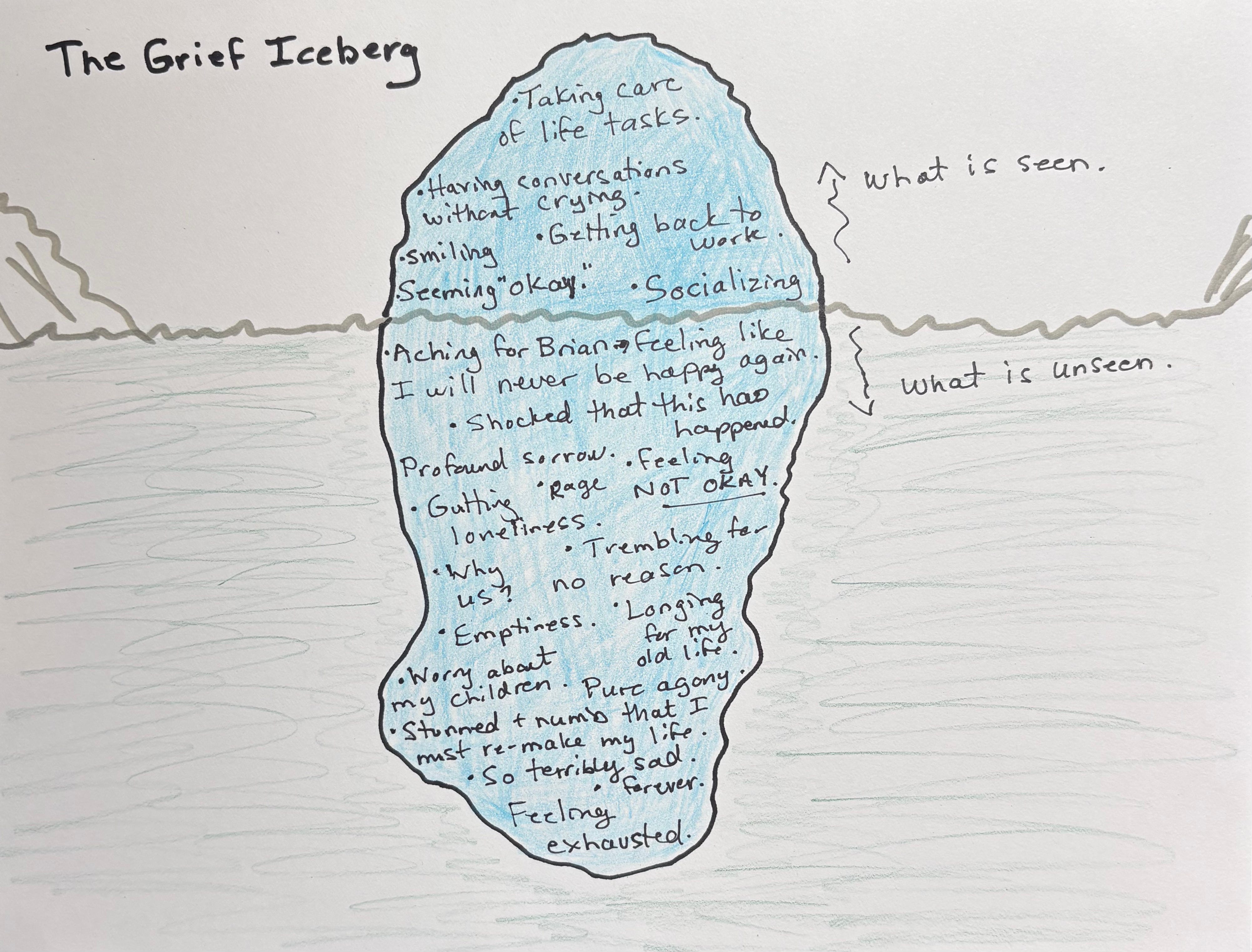
One of the great, isolating addlements of grief is the lack of language to describe that difference—that ability to function and be “okay” and back to things, while suffering tremendously. We don’t have a word for that state of being, perhaps because we’re assured by dichotomies. We don’t want to make a word for the awful land of living/suffering, where the bereaved are forced to live. It is reassuring to believe there is this or that and nothing in between. It is clarifying to stand on one shore or the other. But grief has no shore, as every honest account of the experience tells us. Grief is sinking into the depths of the muddiest waters and trying to swim to the surface and eventually float.
After my essay The Love of My Life was published in The Sun magazine some twenty-four years ago, a few of my friends who knew me in my early twenties said they hadn’t understood how profoundly I was suffering over the death of my mother at the time. It wasn’t entirely their fault. I didn’t have the words to tell them about how so much of grief is hidden in those muddy waters. They only knew what they saw above the surface. Me, hanging in there.
Times have changed a bit. So many writers—yes, me among them—have told murkier, more complex truths about grief and, in great part because of that, our understanding of it has become more nuanced (though there’s still much progress to be made). When my mother died in 1991, I felt like the only young motherless daughter. When my husband died in 2026, I need only to log onto Instagram to see I am not alone in widowhood. One meme that has appeared on my feed again and again in different versions is that of The Grief Iceberg, a deeply consoling illustration of this thing that we don’t have a word for. Here’s mine:
When Brian got his diagnosis and we knew he was going to die one of the things that kept me going was knowing I’d get back to work. That my writing would, as it always has, save me. I think of writing as the unbroken thread of my life. The thing that has filled the emptiness, helped me make sense of the incomprehensible, glimmered the ugliest things with at least some aspect of beauty. Writing is such a sturdy and stabilizing force in my life that thread isn’t really the right word for it. Writing is my rope. The one I’ve used to pull myself upward over and over again. The one that tethers me to meaning and possibility.
I’ll be teaching writing and sharing a good portion of what I know about the art and practice of doing it on October 9-11th at the Omega Institute in Rhinebeck, New York. You can sign up to be there with me on the spectacular Omega campus at a glorious time of year or you can sign up for the livestream and participate from where ever you are (or watch the video of the workshop later, at your leisure). I’m quite a bit behind on promoting this workshop, as I’ve not had the heart to post much online or send out this newsletter for many months, but I hope you’ll clickity click on the above links and register now so we can fill the place to the gills with our beautiful words and maybe also our suffering and maybe also our smiling and maybe all of those things that are both above and below the surface, seen and unseen.
The workshop is for everyone and every time I teach it, my heart is filled with joy and wonder by the magic we make together. You don’t have to be any kind of writer to be there—published, not published, experienced, inexperienced, beginner or advanced. You don’t even have to be a writer at all. You only have to want to see what you find when you write.
I hope you’ll come hang (in there) with me.
Love,
Cheryl
There are no words for a grief so massive. I remember when my mother was dying of cancer at 44 and I was a junior in HS, I begged my teacher for a sign she had in her classroom of a kitten hanging from a limb. It said “hang in there.” She gave it to me happily, generously. No one knew how to help me so I think she was happy to have something. We put it in my mother’s hospital room.
That phrase.
To hear you say it again. Yes. That’s it. Hanging in there. What else can you say?
I am grateful you share the truth of what it feels like and I send you all the love and healing thoughts. It’s unfair and wrong and life does keep moving.
Your writing is a gift to us all.
I'm sorry. Grief is so consuming. When my son died, people kept asking me how I was. Really? How did they think I was? The most polite, pat answer I could come up with was "I am here. I am breathing." And I said that many, many times.